Start with what is not different, because it is most of it.
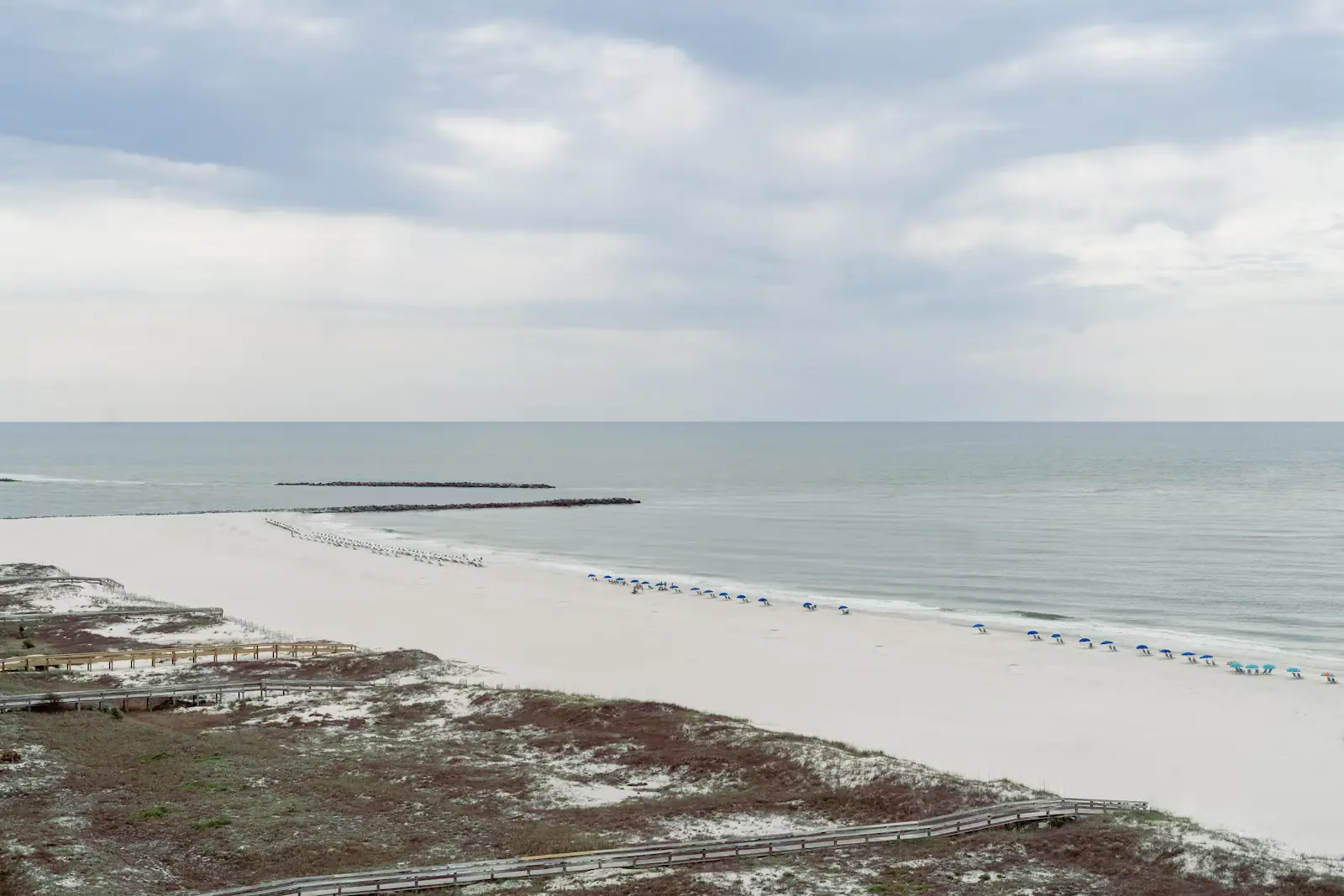
Gulf Shores and Orange Beach sit on the same island, on the same continuous beach, made of the same near-white quartz. They get the same weather, the same water temperature, the same jellyfish on the same onshore wind. They fly the same coloured flag system and both back it with an ordinance that closes the Gulf on a double red. Both require everything off the sand within an hour of sunset for the same turtles. Gulf State Park lies between them and belongs to visitors in either town.
Anyone telling you that one has better sand than the other has never walked from one to the other.
The two towns, and how they got that way
Gulf Shores is the bigger of the two: 15,014 people at the 2020 census, up from 356 in 1960. It has something Orange Beach does not, which is a centre. Highway 59 runs south through town and stops at the sand, and the junction with Beach Boulevard is as close to a downtown as this coast gets — shops, restaurants, the public beach, the festival ground, and the family attractions clustered within a couple of miles.
It has also been knocked down more than once. Hurricane Frederic levelled most of the town in 1979, and much of what you see was built after that.
Orange Beach incorporated on 1 August 1984 and had 8,095 residents at the 2020 census. It is a linear town strung along Perdido Beach Boulevard, with no real centre of the Gulf Shores kind. Its centre of gravity is on the water instead: the marinas on Terry Cove and the back bays, and The Wharf on the Intracoastal Waterway with its amphitheatre, shops and 112-foot Ferris wheel.
The one structural difference: the pass
Everything else in this comparison follows from a gap in the sand at the eastern end of Orange Beach.
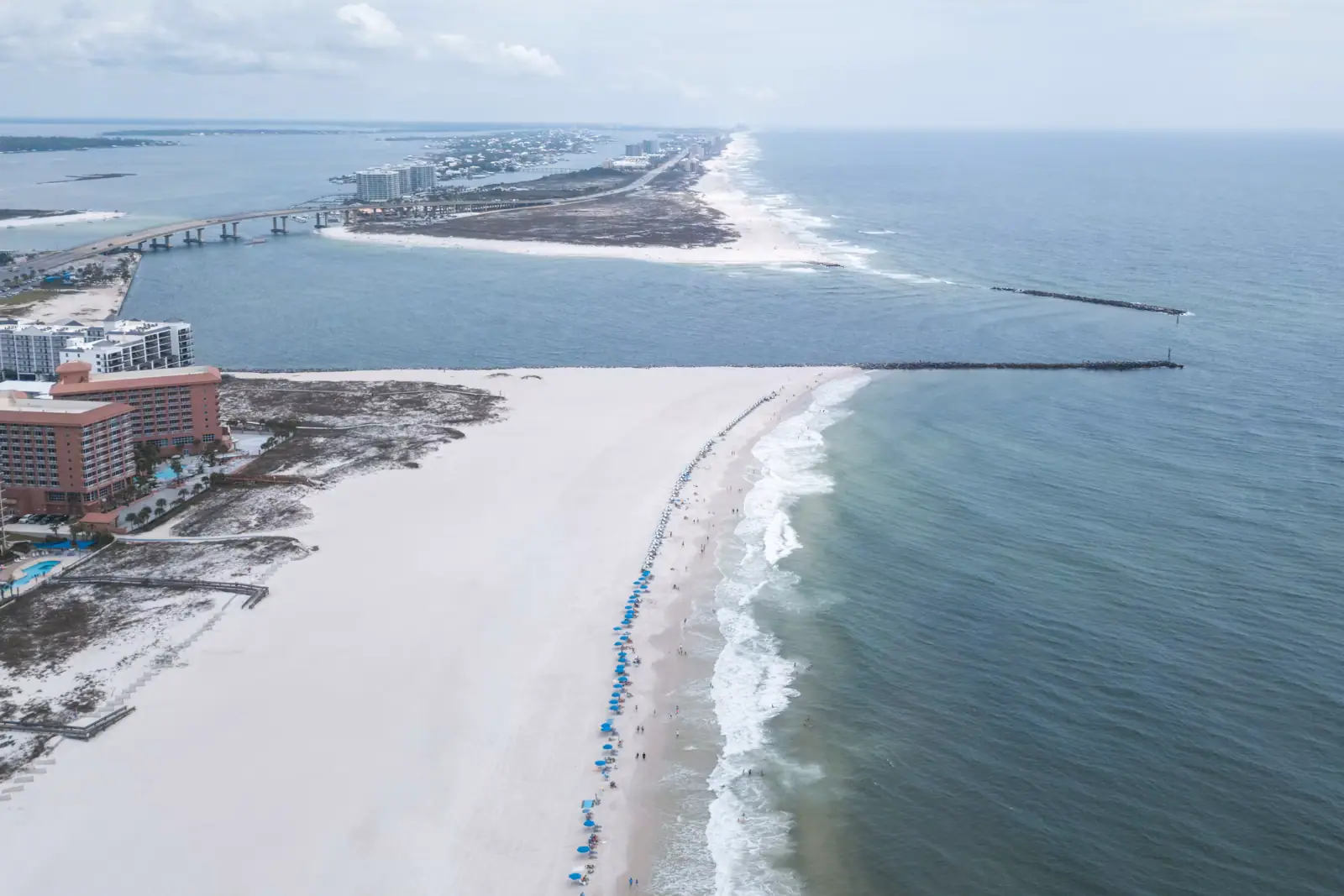
Perdido Pass connects the back bays to the Gulf. The bridge over it carries State Route 182 with a fixed span 54 feet above the channel, there is a jetty on the western side and a weir-and-jetty combination on the eastern, and the longshore drift here runs westward, which is why sand piles up on the eastern side and is scoured from the western.
That pass is the reason the charter fleet, the marinas and the boat-based economy live in Orange Beach and not in Gulf Shores. If your week has a deep-sea trip or a rented pontoon in it, you will be driving to Orange Beach whichever town you sleep in.
Side by side
| Gulf Shores | Orange Beach | |
|---|---|---|
| Feel | A beach town with a centre | A waterfront strip with a marina culture |
| The beach | Identical sand, more public access lots | Identical sand, generally quieter accesses |
| Boating and fishing | Little Lagoon, the state park lakes | Perdido Pass, the charter fleet, the back bays |
| For children | The zoo, Waterville, Adventure Island, the museum | Waterfront Park, the Hot Shop, the Ferris wheel |
| Eating out | More choice within walking distance | Clustered at the marinas and The Wharf |
| Evenings | Festival ground, the town centre | The Wharf amphitheatre, the state-line roadhouse |
| Accommodation | Towers, houses and a wide range on West Beach | Heavier on large Gulf-front towers |
| Traffic | Worst on Highway 59 on changeover Saturdays | Worst on Perdido Beach Boulevard in the evening |
| Price | Broad range, including genuinely cheap weeks | Narrower range, skewing higher on the Gulf front |
Choose Gulf Shores if
You have children under about twelve and want the zoo, the water park and the volcano within ten minutes. You want to be able to walk to more than one restaurant. You want the widest spread of prices, including the older, cheaper buildings on West Beach. You want the state park's beach and campground on your doorstep. Or you want Fort Morgan and the ferry, which is a 22-mile drive west from Gulf Shores and correspondingly further from Orange Beach.
Choose Orange Beach if
Your week has a boat in it, whether that is a deep-sea charter, a pontoon rental or a dolphin cruise. You want the quieter beach accesses at Romar and Cotton Bayou. You want The Wharf on the doorstep for evenings out and the amphitheatre calendar. You prefer a large Gulf-front tower to a walkable street. Or you want to be nearest the state line and the Flora-Bama, which sits about as far east as Alabama goes.
What neither of them is
Neither town has a historic district, an old quarter or a walkable waterfront promenade. Both are car towns built mostly since 1980, and in both of them you will drive to dinner more often than you walk.
Both take hurricanes directly, and the dates are worth sitting with: Ivan made landfall here on 16 September 2004, and Sally made landfall on 16 September 2020. The same date, sixteen years apart. That is coincidence rather than pattern, but it is a useful corrective to anyone who thinks a September booking on this coast is a free lunch.
And neither is cheap in July. The difference between them in peak season is smaller than the difference between peak season and the second week of October in either.
The answer most people arrive at
You will use both. The two town centres are a short drive apart outside changeover traffic, the state park sits in the middle with trailheads in both cities, and almost everybody who stays a week in one ends up spending at least a day in the other.
So book on the practical question rather than the identity one. If the week is built around children and land-based attractions, Gulf Shores. If it is built around a boat, Orange Beach. If it is built around a beach and a balcony, book whichever building is nearer a public access at the price you want to pay, because on that measure the two towns are genuinely interchangeable.
Getting from one to the other
There are two ways east and west along this coast and they behave differently.
Beach Boulevard (State Route 182) runs along the Gulf front the whole way, through Gulf State Park and on into Orange Beach as Perdido Beach Boulevard. It is the scenic route, it is slower, and in the evening it fills with people going to dinner.
Canal Road (State Route 180) and the Foley Beach Express run behind the built strip. Canal Road is the locals' route between the two towns and is usually the faster of the two by a clear margin in summer.
Cycling between them is genuinely practical because the Backcountry Trail links much of the middle of the destination on paved, traffic-free path, with trailheads at both the Gulf Shores and Orange Beach ends.
Whichever you take, the pinch point is the same: mid-morning to early afternoon on a Saturday, when the whole coast changes over at once.
Last updated
Opening hours, ordinances and prices move with the season. We re-check this guide rather than rewrite it, and the date above is the last time someone did. How we research and correct.